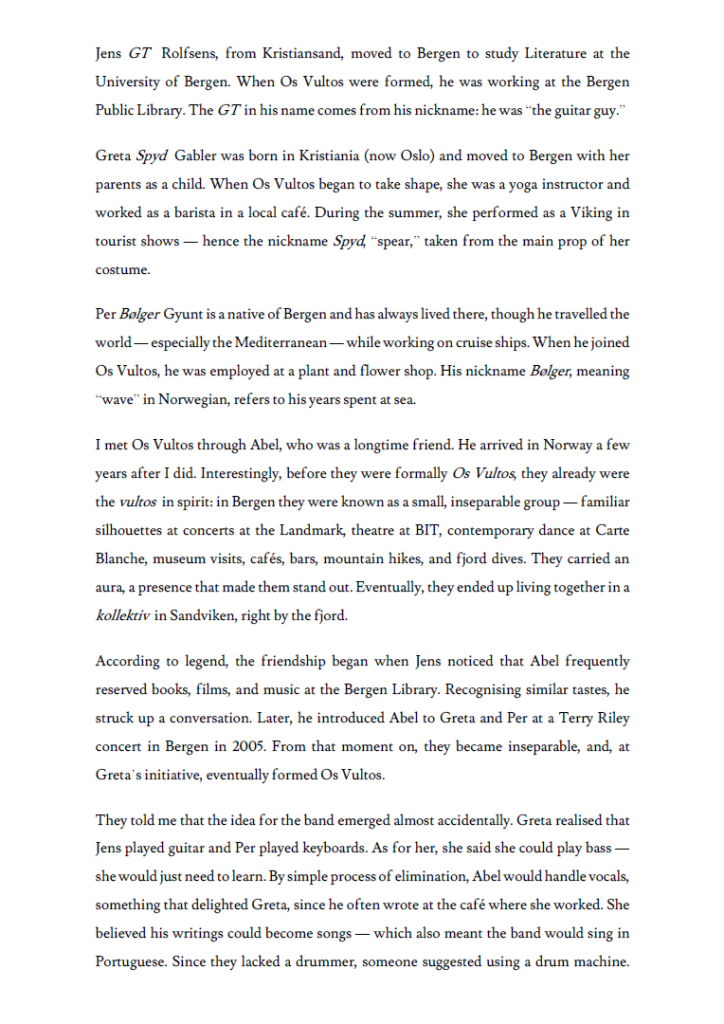
Spectral Works proudly announces a record deal with Os Vultos, a drone, noise, experimental band from Bergen, Norway, for the release of their work. Os Vultos were founded in 2005 and here’s their short story by Artur Salgueiro:
Abel Van Pires, originally from Trás‑os‑Montes, Portugal, emigrated to Norway and spent much of his time in Bergen working at the fish market — a place geared mostly toward tourists and largely staffed by foreigners. The “Van” in his artistic name began as a joke, a nod to the fact that Abel, despite his reluctance, became the band’s frontman.
Jens GT Rolfsens, from Kristiansand, moved to Bergen to study Literature at the University of Bergen. When Os Vultos were formed, he was working at the Bergen Public Library. The GT in his name comes from his nickname: he was “the guitar guy.”
Greta Spyd Gabler was born in Kristiania (now Oslo) and moved to Bergen with her parents as a child. When Os Vultos began to take shape, she was a yoga instructor and worked as a barista in a local café. During the summer, she performed as a Viking in tourist shows — hence the nickname Spyd, “spear,” taken from the main prop of her costume.
Per Bølger Gyunt is a native of Bergen and has always lived there, though he travelled the world — especially the Mediterranean — while working on cruise ships. When he joined Os Vultos, he was employed at a plant and flower shop. His nickname Bølger, meaning “wave” in Norwegian, refers to his years spent at sea.
I met Os Vultos through Abel, who was a longtime friend. He arrived in Norway a few years after I did. Interestingly, before they were formally Os Vultos, they already were the vultos in spirit: in Bergen they were known as a small, inseparable group — familiar silhouettes at concerts at the Landmark, theatre at BIT, contemporary dance at Carte Blanche, museum visits, cafés, bars, mountain hikes, and fjord dives. They carried an aura, a presence that made them stand out. Eventually, they ended up living together in a kollektiv in Sandviken, right by the fjord.
According to legend, the friendship began when Jens noticed that Abel frequently reserved books, films, and music at the Bergen Library. Recognising similar tastes, he struck up a conversation. Later, he introduced Abel to Greta and Per at a Terry Riley concert in Bergen in 2005. From that moment on, they became inseparable, and, at Greta’s initiative, eventually formed Os Vultos.
They told me that the idea for the band emerged almost accidentally. Greta realised that Jens played guitar and Per played keyboards. As for her, she said she could play bass — she would just need to learn. By simple process of elimination, Abel would handle vocals, something that delighted Greta, since he often wrote at the café where she worked. She believed his writings could become songs — which also meant the band would sing in Portuguese. Since they lacked a drummer, someone suggested using a drum machine.
Jens liked the idea, especially because he already had some guitar compositions. Per admitted he also had keyboard pieces that could be adapted. Abel was less enthusiastic: he didn’t want to be the frontman.
The initial intention was never to record albums. They simply wanted to play together. None of them considered themselves particularly skilled musicians; they doubted any band, even a punk one, would take them. They also had no technical knowledge about recording, mixing, mastering, MIDI or sequencing. They began with a handful of songs to see what might work. Their writing and recording sessions took place at AKKS, in the USF Verftet — an association dedicated to promoting diversity in the music scene.
Despite their musical limitations and lack of technical expertise, things somehow flowed. In a surprisingly short time, they found themselves with enough material for three albums. They sent the recordings to friends; most ignored them. They then decided to become a band just for themselves — four people against the world. And so, they continued, recording album after album in quiet, stubborn creativity.
Much has happened since then, both within the band and in their personal lives. So why choose now — and only now — to release Os Vultos’ recordings? That question you’ll have to ask Os Vultos themselves, if you ever meet them on the streets of Bergen. I have always wondered, but never received an answer.
Artur M. Salgueiro